John Dunkin was born about 1744 in Chester County, Pennsylvania. He was the son of Thomas Duncan and Elizabeth Alexander.
He married Eleanor Sharp.
John and Eleanor's children may have included:
Elizabeth (Betsy) Duncan (1766, married Laughlin),
John Duncan, Jr. (1768, married Polly Laughlin),
Margaret (Peggy) Duncan (1770, married Laughlin),
Joseph Duncan (1772)
Mary Jane Duncan (1775, married James Laughlin)
Sarah (Sally) Duncan (1777, married Laughlin)
Anne Duncan (1779, married William Martin),
Faithful Duncan (1782, Abram Locke)
Eleanor Duncan (aft 1782, married Samuel Campbell)
Polly Duncan (married James Hignight).
On February 1, 1763 John Dunkin petitioned the court to buy his younger sibling's inherited land in Sadsbury Township, Lancaster County, Pennsylvania.
On March 1, 1763 Ann Duncan, infant chose her brother, Thomas, to be her guardian.
About 1765, the Duncans settled in Botetourt County, Virginia, near the town of Fincastle.
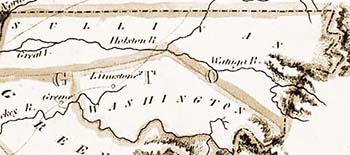
They later moved to Washington County, Virginia where they settled on the north bank of the south fork of Holson river above the mouth of Spring Creek.
In 1770 the Washington County Court recommended John to Commission of the Peace.
In 1773, John Duncan was added to the committee to find the best way for a horse road between Town House on the Holston and Castlewoods.
In June, 1776, just prior to the outbreak of the Cherokee War, Captain Dunkin led a party of militia and settlers into Powell Valley.
In 1777, John was commissioned a captain in the militia was sworn in as justice of Peace.
In 1777 they moved to Kentucky
In 1780 the Duncans were captured at Riddles and Martin's Station and taken as prisoners to Canada where they were prisoners until the close of the war when they were exchanged and returned to the United States.
When he returned he stated
June 26, 1780, I was taken from Licking Creek in Kentucky County by Captain Henry Bird of the 8th Regiment of his Majesty's forces in conjunction with about eight hundred Indians of different Nations--Viz. Mingoes, Delawares, Shawnees, Hurons, Ottaways, 'Taways and Chippeways.
We marched from our village the 27th, being in number 129 men, women and children. We marched down Licking about 50 miles to the Ohio and from thence up ye Big Miami River about 170 miles to the Standing Stone, and from thence up said river to Larramie's [Lorimer's] Store 14 miles on the head of the Miami; and from thence across by land 18 miles to the Landing on the River Glaise-
-and from thence down said river passing a Taway village and to the mouth of said river about 80 miles at a small village to Miami Indians on the River Miami; from thence down said river about 40 miles to an Indian village called Rose de Boo
--and from thence down said river about 18 miles to Lake Erie, where we went on board the Hope, mounted six pounders, Captain Graves, Commander; and so across the said lake to the mouth of Detroit River, and 18 miles up to the same to the fort and town of Detroit, which place we arrived at the 4th of August, 1780
--where we were kept until the 24th when 33 of us were put on board the Gage, Captain Burnit commander, mounted 8 guns, and from thence to Fort Erie and thence in battles 18 miles down the River Niagara to Fort Slusher, at the head of the great fall
--and from thence in wagons, 9 miles, where we again went in battles down said river to Fort Niagara at the mouth of said river on the 19th;
and on the 5th of September we were again put on board the Ontario, Captain Cowan commander and so across the Lake Ontario to Carlton Island on the 8th, and on the 10th we sent off down the long Sac and into Sandijest Lake, and so down Rapids into Grand River and through a small lake and so the Lasheen.
From thence by land 9 miles to Montreal on the 14th of September, 1780, and on the 17th we were sent into Grant's Island and remained there until the 25th of October, when we were again taken back into Montreal and billeted in St. Lawrence suburbs.
I was put in confinement in the Long Gaol September 1st, and remained in close confinement until the 17th day of October, when I was permitted to go and live with my family with the privilege of walking the town and suburbs.
In 1781
On motion of James Laughlin & John Litten by the consent and Order of the Court they are appointed Guardians of the Estate of Captain John Dunkin & Solomon Litten prisoners with the Enemy in Canady and to use all legal methods for saving and securing the Said Estate whereupon they together With William Davison and John Vance entered into and acknowledged their bond in the Sum of Eight Thousand pounds for the faithful performance of the Same.
After the war, they returned to the Holston area. They had lost their land, their possessions, and the people they had enslaved.
In 1786, Hawkins County was taken from Sullivan County, Tennessee. A Commission including Joseph Martin, James McNeil, John Duncan, William King, Evan Shelby, Samuel Smith, and John Scott were selected to find a site for the county courthouse.
In 1788 John attended the convention as a representative from Sullivan County to consider ratification of the Federal Constitution. He voted against ratification.
Eleanor died in 1816 and John died about 1818.
|